
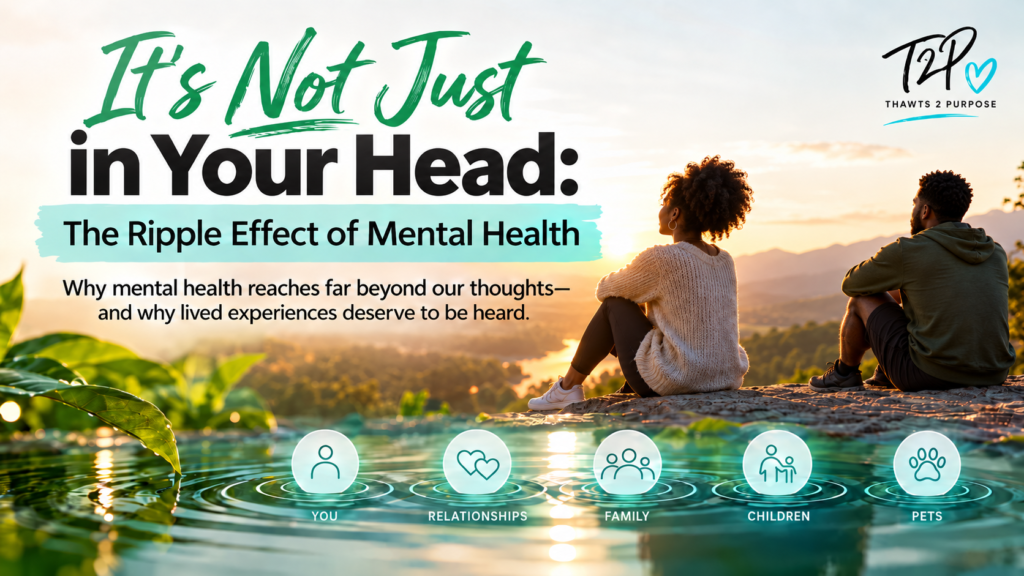
World Mental Health Day 2026: It’s Not Just in Your Head
The ripple effect of mental health—and why lived experiences deserve to be heard.
Mental health is something every one of us has, yet it is still often discussed as though it only matters when something has gone seriously wrong.
We understand the importance of taking care of our bodies. We recognize the need for rest when we’re physically exhausted, medical attention when we’re in pain, and treatment when something isn’t functioning as it should.
Our mental health deserves that same consideration.
This year’s World Mental Health Day theme, “Lived experiences heard: real voices, real change,” reminds us that understanding mental health requires more than statistics, diagnoses, or professional definitions. It also requires listening to the people who have actually lived through these experiences and recognizing what those experiences can teach us.
Mental health doesn’t stay neatly tucked away inside our minds. It can influence our bodies, our everyday lives, our relationships, our families, and the way we experience the world around us.
That ripple can reach much further than we realize.
The Mind and Body Aren’t Separate
One of the easiest ways to underestimate mental health is to think of it as purely emotional.
It isn’t.
Stress can affect both the mind and the body. The World Health Organization notes that excessive stress can contribute to difficulty concentrating, headaches and other body pain, stomach problems, trouble sleeping, anxiety, and irritability.
That connection can work in both directions. Physical illness, chronic pain, and other health challenges can affect emotional well-being, while ongoing emotional strain can make caring for physical health more difficult.
Yet we often treat the two very differently. Physical discomfort may prompt concern quickly, while emotional exhaustion can be dismissed as something to simply push through.
Recognizing mental health as part of overall health changes that conversation. What happens emotionally matters because our minds and bodies aren’t operating in separate worlds.
Mental Health Shows Up in Everyday Life
The impact isn’t always dramatic.
Mental health can influence concentration, memory, motivation, productivity, decision-making, and the ability to keep up with ordinary responsibilities.
Sometimes those changes happen gradually enough that they simply become part of someone’s routine. Things become harder. Interest fades. Energy changes. Responsibilities become more difficult to manage.
Someone can continue going to work, caring for a household, attending school, raising children, and handling responsibilities while still struggling internally.
That is part of why lived experiences matter so much. We cannot always determine what someone is carrying simply by looking at how well they appear to be functioning.
Mental health exists beyond what is visible.
When Stigma Teaches Us to Stay Quiet
Even recognizing that something is wrong doesn’t necessarily mean someone feels comfortable addressing it.
The messages people receive about mental health can begin long before they ever experience a mental health challenge themselves.
Gender expectations can play a role. Many men grow up hearing some version of be strong, toughen up, handle it, or don’t cry. A 2025 meta-analysis found that stronger adherence to certain traditional masculine expectations was associated with more negative attitudes toward seeking psychological help and greater self-stigma around doing so.
Women can experience another version of that pressure—the expectation to keep everything together, remain dependable, care for everyone around them, and continue functioning while their own emotional needs repeatedly move further down the list.
Culture, family traditions, faith, and community expectations can shape these views as well.
In some families and communities, emotional struggles may be considered private. Professional mental health care may be unfamiliar, mistrusted, or associated with shame. For some, faith or spiritual guidance may be the first place emotional struggles are discussed. For others, generations of survival may have taught people to suppress difficult emotions rather than openly examine them.
A systematic review examining mental health stigma across racial and ethnic minority groups in the United States identified factors including family concerns, cultural beliefs, access and quality of services, and stigma itself as barriers surrounding mental health care.
Access, cost, trust in healthcare systems, language, and previous experiences with care can create additional barriers.
These influences help shape the way people understand mental health—and sometimes whether they believe asking for help is acceptable at all.
The result can be generations of people learning how to survive something without ever learning that they are allowed to talk about it.
That is one reason real voices matter.
Mental Health Can Change the Way We Connect
Our emotional well-being also travels with us into our relationships.
That includes marriages and romantic partnerships, but it doesn’t stop there. It reaches relationships between parents and adult children, siblings, extended family members, friendships, coworkers, and the people who make up our everyday support systems.
Communication can change. Patience can change. Emotional availability can change. Conflict may become harder to navigate, or someone may gradually withdraw from people they once felt close to.
Sometimes relationships begin changing before anyone involved recognizes mental health as part of what is happening.
A multinational study involving more than 30,000 people across 12 countries found that several premarital mental disorders were associated with a higher likelihood of later divorce.
That finding doesn’t explain why any individual relationship ends. Relationships are far more complex than one factor. What it does show is that emotional well-being can be a meaningful part of the larger picture of how relationships function and change over time.
Mental health may be experienced individually, but its effects aren’t always limited to the individual.
Children Are Part of the Experience, Too
That ripple becomes especially important within families.
Children are developing their understanding of emotions, relationships, communication, conflict, and coping while watching the adults around them.
They don’t need to understand words like anxiety, depression, burnout, or emotional exhaustion to recognize when something feels different.
A parent’s mental health can influence emotional availability, reactions, routines, communication, and the overall environment within a household.
At the same time, children and teenagers have their own mental health experiences.
The Centers for Disease Control and Prevention notes that the quality of the relationships and environments where children and adolescents grow up helps shape their well-being and development. Mental health during childhood also influences how young people learn, build relationships, cope with challenges, and function at home, at school, and within their communities.
Looking at mental health through a family lens helps us recognize how emotional experiences can reach across generations.
The experiences of adults can affect children, and the experiences of children can affect the families caring for them.
Understanding that connection gives us another reason to take mental health seriously.
And Yes, Even Our Pets Can Feel the Ripple
Our responsibility to others can even extend beyond human relationships.
Pets depend on their caregivers for food, exercise, affection, interaction, routine, and stability. When someone is struggling to manage everyday responsibilities, caring for an animal can become more difficult as well.
It is another reminder of how far the effects of our well-being can reach.
Real Voices Can Create Real Change
Facts help us understand mental health. Research gives us evidence. But lived experiences give those facts context.
Behind every statistic is an actual life—someone working, parenting, loving, grieving, struggling, healing, trying again, or simply figuring out what they’re experiencing.
And no one person’s experience represents everyone else’s.
That is exactly why we need more voices, not fewer.
The World Health Organization’s 2026 World Mental Health Day campaign emphasizes the importance of hearing people with lived experience and recognizing the value those voices bring to conversations, services, policies, and decisions surrounding mental health.
When people are able to speak about mental health without automatically being judged, dismissed, labeled, or shamed, we make room for greater understanding.
When we listen to experiences outside our own, we can begin challenging assumptions and beliefs we may not have realized we carried.
And when lived experiences become part of the larger conversation, awareness has the opportunity to become more than a hashtag or a designated day.
It can become change.
This World Mental Health Day, the message isn’t simply that mental health challenges exist.
Mental health matters—in our bodies, our daily lives, our relationships, our families, our communities, and in the lives of those who depend on us.
And sometimes real change begins when someone’s experience is finally heard.
Thawts bring clarity. Clarity brings change.
This article is intended for general education and awareness and is not a substitute for professional mental health or medical care.
Stay in the Thawt Loop
Fresh thawts, gentle reminders, and quiet support—sent your way.
No pressure. No perfection. Just support when you need it.
Enjoyed this? Join the Thawt Circle
Get more cozy, realistic wellness tips — straight to your inbox.
Sign Up Now